
 As part of the 2026 season “TRAVEL LIKE ROYALTY”
The magic of faraway places will take centre stage at the Royal Château of Amboise in 2026. Throughout the season, visitors will be invited to follow in the footsteps of their Renaissance predecessors as 21st-century travellers.
– EXHIBITION – FROM 9 JUNE TO 20 SEPTEMBER
“On the trail of the travelling princes”
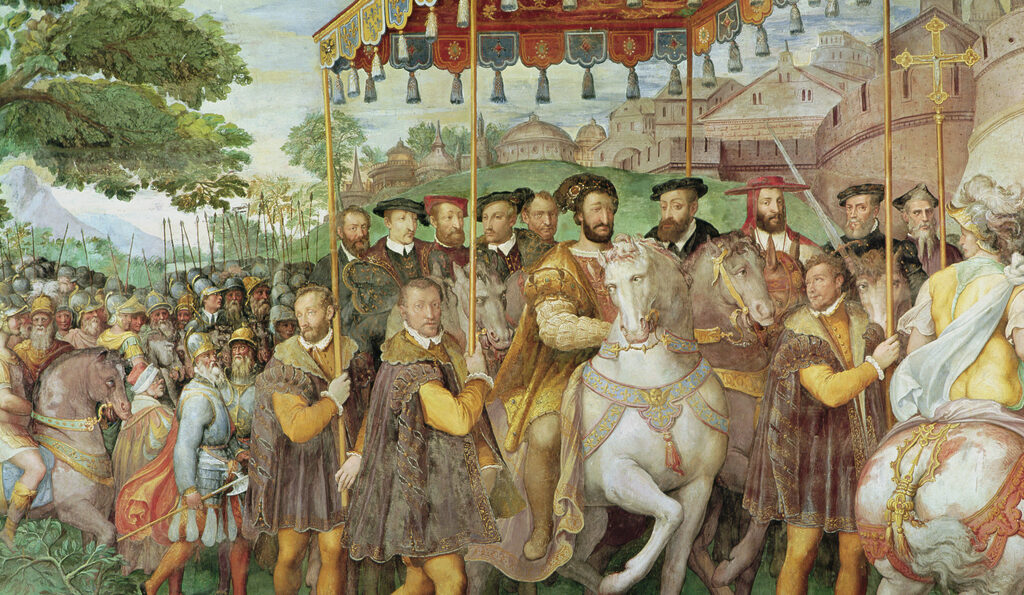
The courts of the Renaissance were undoubtedly the most nomadic of the Capetian dynasty’s courts: whether travelling the roads of the kingdom or on campaigns, the king would set out at the head of a procession of several thousand attendants, taking on the air of a Roman triumph. These frequent journeys of the French court during the Renaissance had real political significance and contributed to the gradual consolidation of the royal power of the French monarchs. They thus mobilised all the resources of the royal households, from the king himself down to the humblest of servants. Whilst these journeys might be paved with glory, they sometimes led to misfortune and humiliation, as at Péronne or Pavia. And when he did not set out on the road himself, the sovereign supported other expeditions setting out to explore an unknown world in the hope of opening up new trade routes. All these journeys would have consequences not only for the assertion of royal power but also, within the societies of the time, in economic, political and artistic spheres.
Amboise, one of the key destinations for travel during the Renaissance
As the palace of the kings of France during the Renaissance and, as such, a symbol of power, the Royal Château of Amboise stood at the heart of the kingdom for over a century, whilst also serving as one of the epicentres of a world opening up to new horizons. From Anne of Brittany’s wedding journey to the voyages to the New Worlds undertaken by Verrazano, Jacques Cartier and Villegagnon at the behest of Francis I, via the successive military expeditions to the Italian peninsula, it is this mobilisation of royal power that will be brought to life nearly 500 years later.
The exhibition is included in the castle admission ticket and does not require booking.